

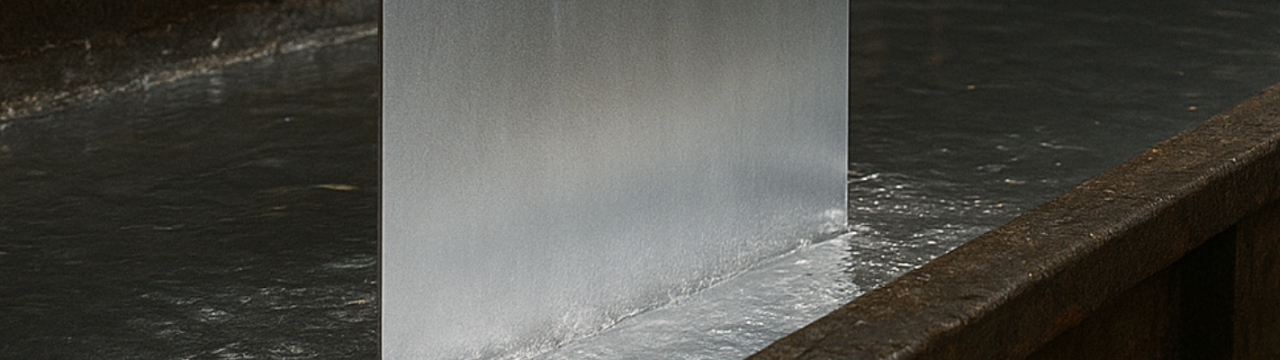
Applying a zinc coating protects steel from corrosion and extends the lifespan of steel products. In the hot-dip galvanizing process, an air knife controls the zinc layer thickness. The interaction between the turbulent air jet and the liquid zinc film induces small irregularities in thickness and surface morphology. This so-called “waviness” leads to product rejection for high-quality applications, increased material use, and higher environmental impact.
In this project, Delft University of Technology and Tata Steel combine their expertise to fundamentally study the air–zinc interaction. Advanced experiments and numerical simulations will be used to analyze the flow and instability mechanisms. The results will provide validated models and design guidelines for improved process control, enabling thinner, more uniform coatings with reduced material consumption, lower emissions, and higher product quality.