

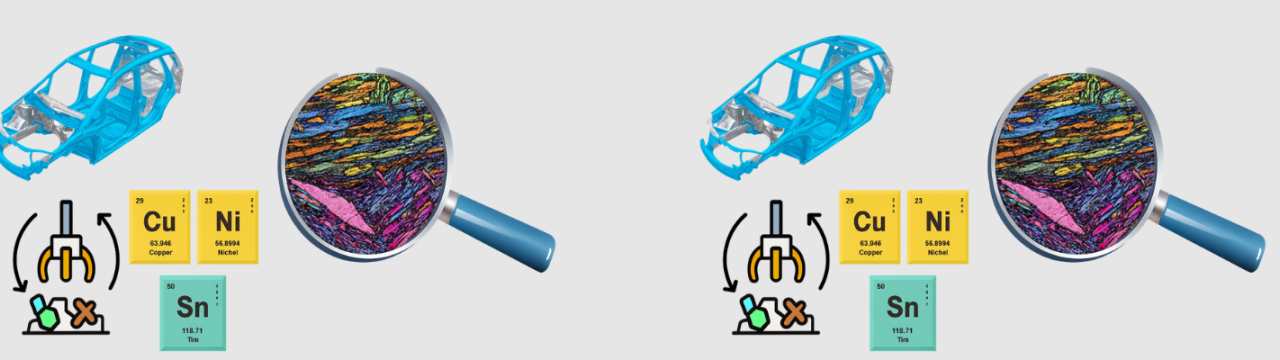
The TERMS project investigates how these tramp elements, particularly copper (Cu), tin (Sn), and nickel (Ni), influence steel behaviour during hot rolling, cold rolling, and annealing. This knowledge is essential for high-strength steels such as DP800, widely used in the automotive sector. At TU Delft, steels containing controlled amounts of these elements are examined using advanced techniques such as SEM, EBSD, and 3D-APT to reveal microstructural changes at the micro- and nanoscale.
The results will help Tata Steel Netherlands optimize process parameters to produce high-quality steel with a higher share of scrap. In doing so, the project contributes to the circular economy, CO₂ reduction, and the development of expertise in sustainable metal production. TERMS strengthens collaboration between academia and industry and supports the transition toward a low-emission, future-proof steel industry in the Netherlands.