

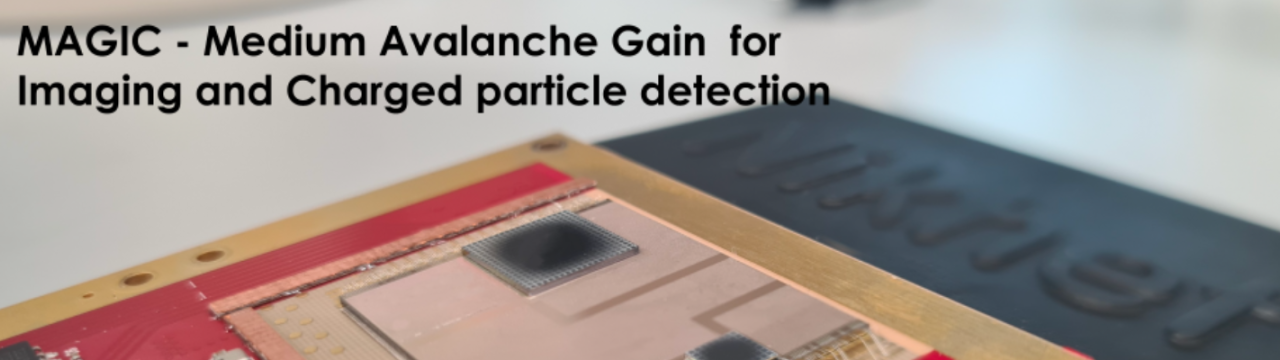
MAGIC targets a gap in fast photon and particle detection. Current systems rely on light intensifiers or very high gain devices that trade timing and spatial precision for sensitivity. The project will create medium gain silicon sensors, integrated with fast pixel readout, to unite micrometre spatial accuracy with picosecond timing. This capability is needed for the High-Luminosity LHC, for mass spectrometry imaging, and for quantum optics where precise, high-rate photon timing is essential.
New sensor technology
Evolving from fast-timing research for high-energy physics at Nikhef, MAGIC advances quantum experiments that hinge on precise time-tagged coincidences and spatially resolved wavefronts. Tpx3Cam already enabled time-correlated counting, ghost imaging, Hong–Ou–Mandel interference, and wide-field lifetime and spectroscopic imaging; TPX4Cam raises throughput and tightens timestamps with pixel-level corrections. Medium-gain sensors extend sensitivity, easing reliance on intensifiers, lowering flux, and boosting visibility and statistics in interference, correlation spectroscopy, and entanglement-based imaging at higher event rates.