

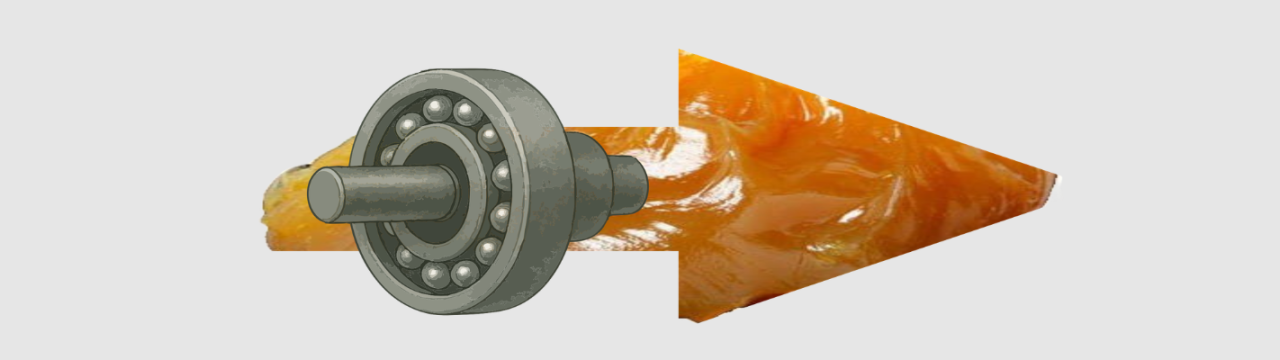
Roller bearings are crucial, critical and high-tech machine components of expensive and maintenance-sensitive equipment like wind turbines, robotic systems and other high-tech machinery.
Most rolling bearings are lubricated with grease. Lubricating grease has a complex structure and has complex semi-fluidic, semi-solid properties. Importantly, it ages in a running bearing via shear and compression (thermo-mechanical degradation), and via oxidation (thermo-chemical degradation), giving it a finite life. Grease life is also shortened by contamination.
The primary objective is to establish the scientific and technological framework to develop and implement a robust re-lubrication strategy that reduces grease consumption by at least 50% and improves bearing reliability by extending the mean time between failures (MTBF) by 50%, based on field test data and operational benchmarks.