

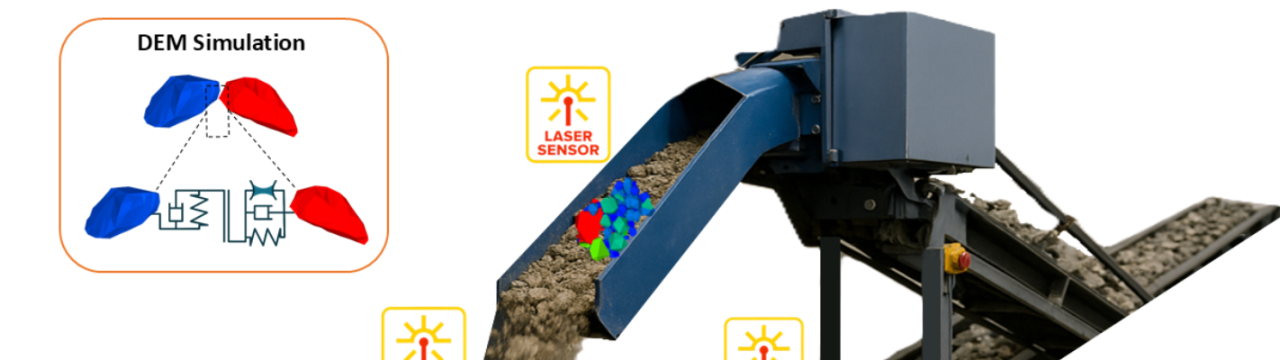
Characterizing large volumes of heterogeneous granular materials presents a significant challenge, particularly for critical raw materials (CRMs) such as ores and industrial scrap. Material properties like particle size, shape, density, and composition can lead to segregation and inhomogeneous flow, complicating representative sampling and analysis. Material handling under harsh industrial conditions further increases the difficulty of accurate and representative material characterization.
SMART-LIBS aims to improve the accuracy and reliability of CRM characterization under real-world industrial conditions, by modelling the material behavior itself. Using Discrete Element Method (DEM) simulations to model granular flows will provide segregation patterns and the effects of material properties. Insights from these simulations will inform strategies for representative sampling, including optimal locations for analytical measurements using LIBS (Laser-Induced Breakdown Spectroscopy). Validation on a simplified lab-scale system will be conducted to refine these strategies and deepen fundamental understanding.