
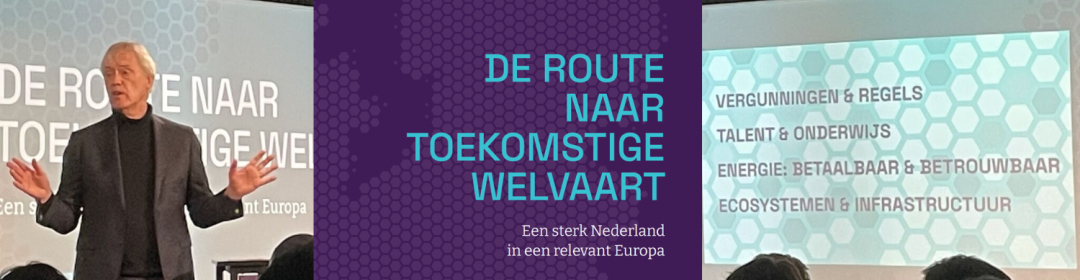
In the report "The road to future prosperity" (12 December 2025), prepared for the Ministry of Economic Affairs, Peter Wennink argues that the Netherlands is at a crossroads. Without higher labor productivity, the financing of public services will come under structural pressure. According to the report, achieving at least 1.5% to 2.0% structural growth requires €151 to €187 billion in productivity-enhancing investments.
Peter Stolk, chair Holland High Tech:
The presented recommendations form an essential basis for strengthening the innovation and industrial landscape in the Netherlands, including the high-tech sector.
Four Strategic Domains, with Concrete Propositions
The report includes a broad public-private inventory: 51 detailed propositions with a combined investment potential of €126 billion, 70% of which is private. The multi-year pipeline is intended to serve as the core of a Dutch investment and industrialization strategy. The recommendations are clustered into four domains that directly address the knowledge and innovation challenges:
- Digitalization & AI: €49.3 billion (including AI Gigafactory, Quantum Valley, photonic chips, robotics).
- Energy and Climate Technology: €26.3 billion (including greening crackers, CCU/carbon technology, hydrogen chains, battery and critical minerals projects, PFAS removal).
- Life Sciences & Biotechnology: €37.9 billion (including Biotech Nexus, ATMP campus, diagnostics platforms, AI in imaging, and interventions).
- Safety & Resilience: €2.9 billion, with an emphasis on niches such as drone ecosystems, satellite capacity, and autonomous maritime systems, building on existing programs.
Preconditions: From Policy to Implementation Capacity
The report states that the Netherlands is not struggling with a lack of ideas, but with obstacles in practical implementation. Topics mentioned include:
- Slow and uncertain permitting, and the nitrogen lock that blocks development.
- Grid congestion (more than 14,000 companies are waiting for connection) and relatively high electricity prices.
- STEM talent shortages and obstacles for international knowledge workers
The report also highlights the structural vulnerability of the digital infrastructure (undersea cables/data centers/fiber optics) and the importance of innovation ecosystems and mainports as economic hubs.
New instruments: NIB and NABI
According to the report, €62 billion in public investment in preconditions is needed to realize the innovation agenda (ten-year forecast). In addition, two "anchor institutions" are proposed:
- National Investment Bank (NIB)
This combines existing instruments and provides public-private financing for investments in technology and infrastructure; €10–20 billion in working capital can mobilize up to €100 billion - National Agency for Breakthrough Innovation (NABI)
DARPA-like, autonomous, with a €1.5–2.0 billion multi-year budget; including a strategy in which the government increasingly acts as a launch customer
Governance: Chief of the matter, Commissioner, and Investment Council
The report advocates a governance shift to break down silos and accelerate progress: future prosperity must be the chief of the matter at the highest political level, supported by an independent Commissioner for Future Prosperity with an implementation unit, fund, and legal enforcement power, and with a National Investment Council for structural public-private coordination.